
Compression Stockings
Graduated compression for the legs
Graduated compression stockings for the legs. Compression garments should be selected and fitted with professional advice.
Compression is a fitted product, not a size guess
Graduated compression stockings are constructed so that the pressure is greatest at the ankle and decreases up the leg. That gradient is the whole point of the garment, and it only works if the stocking is the right size for the leg it is on. A stocking that is too large does not deliver the gradient; one that is too small can restrict rather than assist.
Because of that, compression is the one part of this catalogue where we ask you not to choose on appearance or on your usual clothing size.
Narrow it down
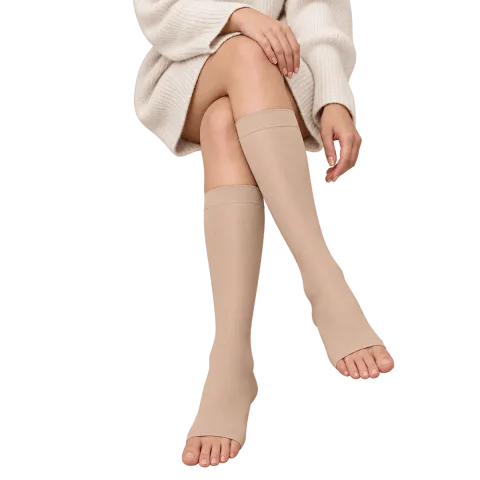
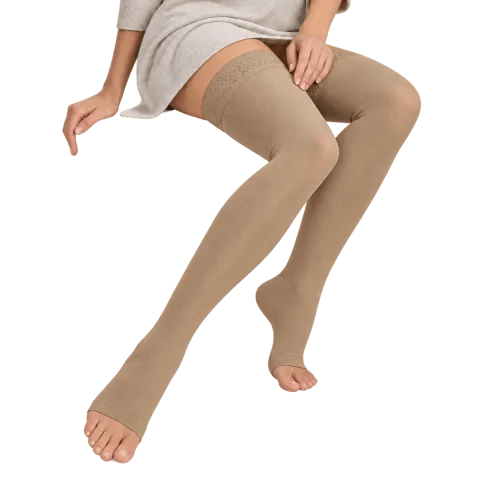
Getting the fit right
A stocking that fits is even from the ankle upwards, with no folds, no rolled top band and nothing cutting in behind the knee. It should take effort to put on and should not hurt once it is on. Numbness, tingling, a cold foot or a change in colour means it comes off and the person who fitted it is told. Never fold the top band over to shorten it.
Choosing the right one
Choosing compression stockings
- Measure in the morning, before the leg has had a chance to swell. Measurements taken in the evening will send you to the wrong size.
- Follow the measuring points in the size table exactly. Compression sizing is not based on shoe size or clothing size.
- Ask a professional first. Compression garments should be selected and fitted with advice from a clinician or a trained fitter, who can confirm both that compression is appropriate for you and which class you need.
- Circulation matters. Compression is not suitable for everyone. If you have or suspect arterial circulation problems in the legs, or you have reduced sensation in your feet, do not start compression without medical advice.
Stop wearing the stockings and seek advice if you develop new pain, numbness, tingling, colour change in the toes, or skin that is broken or does not recover after the stocking is removed.
If you are recovering from surgery or an injury, or you have been given a specific brace to wear, follow the instructions of the clinician who prescribed it. Nothing on this page replaces that advice.
To see the differences, put Class 2 Below-Knee Compression Stockings (AD) (V40) and Class 2 Thigh-High Compression Stockings (AG) (V60) side by side.

Care and safety
Common questions
Can I choose my own compression class?
We would not advise it. The class should be decided by the clinician or fitter who assessed you, along with the length and style.
Can I wear them overnight?
Only if you have been told to. Many compression garments are intended for daytime wear and are removed before sleeping.
How do I know they still work?
By age and use, not by appearance. A stocking that has become easy to put on has usually lost some of its compression.
Putting them on and looking after them
Compression stockings are easiest to put on first thing in the morning, on dry skin, with the stocking turned inside out to the heel and then rolled up the leg. Never fold the top down to shorten them — that doubles the pressure at one point on the leg, which is exactly what the graduated construction is designed to avoid.
Elastic fibres wear out. Compression garments have a working life and lose their effectiveness with washing and wear; replace them on the schedule you were given rather than when they look worn.
Supports for the neighbouring areas are gathered in Knee Supports and Ankle Supports.
Compression stockings
Measurements are taken at specific points on the leg and, for best results, in the morning before any swelling has built up during the day. Class and length are two separate decisions: the class is the pressure the stocking applies, the length is how far up the leg it reaches. Both belong with the clinician who prescribed or fitted them rather than with preference.